
After LASIK-family surgery in Seoul you recover at your hotel, not a separate center. Plan about 3–5 days, with exam and surgery often on the same day and a check-up the next day before you fly.
Is there a Korea LASIK recovery center, or do you recover at your hotel?
Your days in Seoul, from landing to the flight home
Which method changes your recovery days?
What do reviews say about recovery, and which parts hold up?
What decides the cost for your case?
The first weeks after you fly home
Risks and side effects to know
Why I want to see you the morning after
Wondering whether you need a Korea LASIK recovery center, or whether a hotel room and the right dates will do, to fit eye surgery into a short break?
Read this before you book the flight or the room.
You'll know what decides the cost, what reviews get right and wrong about recovery, which method changes your timeline, and how many days to plan in Seoul. That's enough to pick dates that fit both your leave and your budget.
Hello, I'm Dr. Baek Dong-won, Representative Director of EYEONCE Eye Clinic in Seoul. I'm a former Clinical Instructor in the Department of Ophthalmology at Samsung Seoul Hospital, and a member of both the Korean and the American Society of Cataract and Refractive Surgery.
At EYEONCE, the surgeon who evaluates you is the surgeon who operates on you and follows your recovery, and that's me. We're a Seoul-government-registered clinic for international patients, with in-house interpreters on-site in English, Chinese, Mongolian and Thai. Our lifetime aftercare continues after you fly home.
I'm writing this because travelers tend to book the hotel and the return flight first and squeeze the check-up in last. The check-up is the date the rest of the trip should hang on.
After SMILE LASIK, LASIK or LASEK, you recover in your own hotel room. For laser vision correction a stay of about 3–5 days is typical, with the exam and surgery often on the same day and a check-up the next day before you fly home.
If you already have a few dates in mind, send your current glasses or contact lens prescription and the days you can take off on WhatsApp, with one question: which day should surgery fall on so the check-up lands before my flight? You'll have your own numbers and your own calendar in one thread before you spend anything.
Laser vision correction is outpatient surgery. You generally leave the clinic the same day and spend the first night wherever you're staying. The FDA's guide to what to expect during and after LASIK tells patients to arrange a ride home and to expect a first follow-up visit soon after surgery.
So the Korea LASIK recovery center most people picture is really three ordinary things: a quiet room near the clinic for the first night, the next-day check, and someone to contact once you're home. You can plan the first two from this page. The third is our lifetime aftercare; ask about the details when you consult.
For the room, look within a short taxi ride of Sinnonhyeon in Seocho-gu, where we are, and don't pay extra for a view. Many people find light uncomfortable on the first evening, especially after LASEK, so heavy curtains help more than a skyline. From Incheon Airport, we have directions for a taxi, the AREX train plus the subway, or the limousine bus.
The first evening is mostly doing nothing. Keep your eyes closed when you can, use your prescribed drops on schedule, and don't rub them. Wear the protective shields while you sleep for the first few nights.
We're open Monday, Tuesday, Thursday and Friday 09:00–18:00 and Saturday 09:00–16:00, with a lunch break from 13:00 to 14:00. We're closed on Wednesdays and Sundays. Appointments are required and registration can close early, so book the exam day before you book the flight.
Say you teach English in Tokyo, wear soft contacts at around -4.00 D, and have Thursday to Sunday free plus a Wednesday evening flight. Here is how that trip could line up against our hours.
| Day | At the clinic | What you plan |
|---|---|---|
| Wednesday | Closed | Land, check in, early night |
| Thursday | Precision exam, and surgery the same day if you're a suitable candidate | A companion or a taxi back to the hotel |
| Friday | Next-day check-up | Rest, sunglasses outdoors |
| Saturday | Open 09:00–16:00 | Spare day before the flight |
| Sunday | Closed | Fly home |
Two things decide whether that plan holds. First, your contacts have to be out long enough for accurate measurements: at least 5–7 days for soft lenses, at least 3 weeks for hard or RGP lenses, and at least a month for ortho-k. In your case that means glasses at work the week before the trip.
Second, the exam has to show your eyes are safe for surgery on that Thursday. If it doesn't, the plan changes, and that is exactly why the measuring comes first.
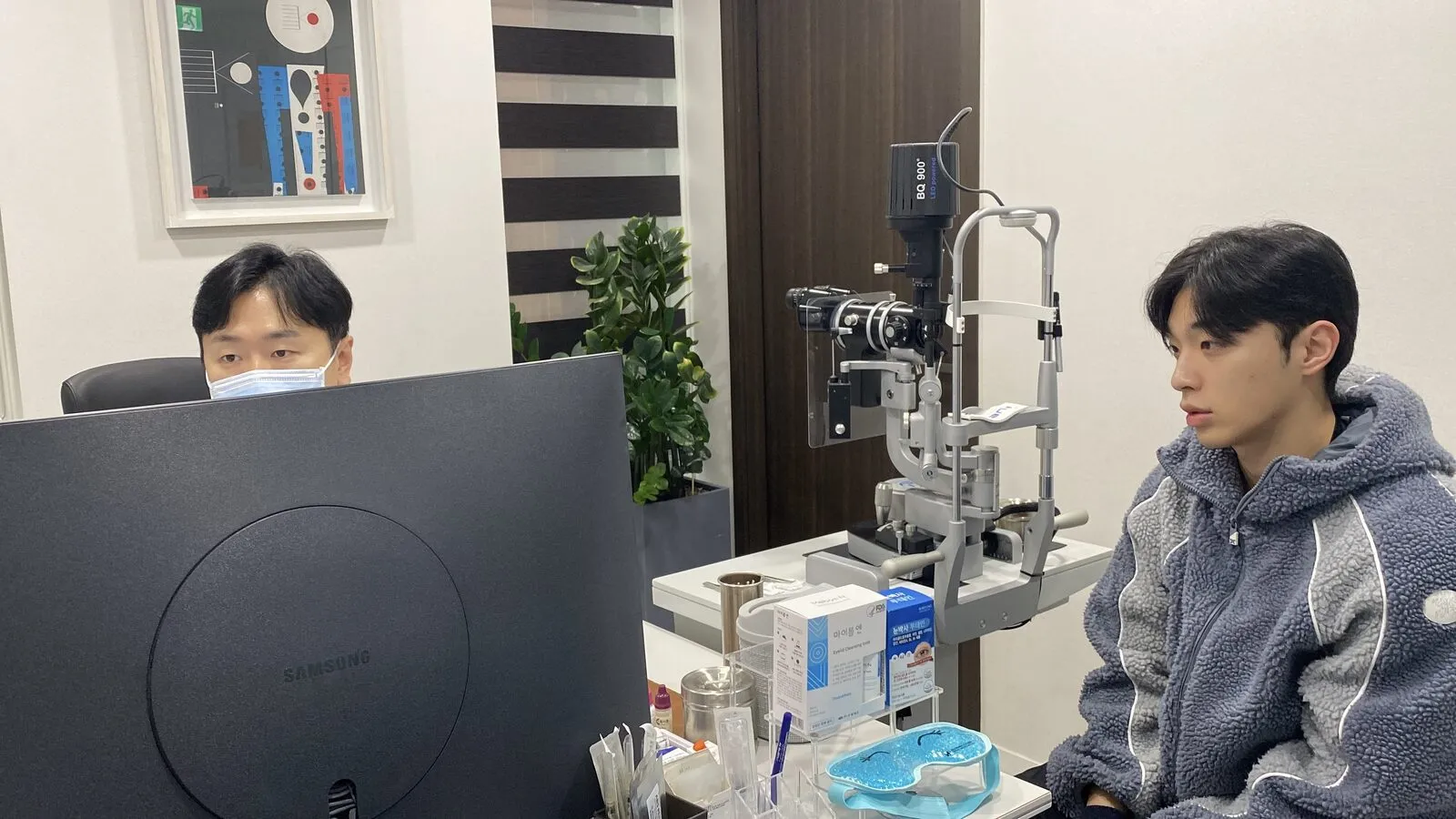
For a traveler, the date of the return flight matters to me almost as much as the prescription. Every safe outcome starts with measurement, and measurement needs a day where nothing is rushed. If your exam points to a procedure with a slower first week, I'd rather you move your leave than hurry your eyes onto a plane. We only go ahead when your pre-op precision exam shows you're a safe candidate.
Before you lock in the return flight, send its departure time along with any recent eye exam results you have, especially a corneal thickness reading if a clinic at home has measured one. Ask whether a Thursday surgery with a Friday check fits your eyes. I review it personally before you book a flight.
What changes for your trip is mainly the first week.
SMILE LASIK is done on our Ziemer FEMTO Z8 femtosecond laser through a 2–4 mm keyhole incision, with no corneal flap. Most people see clearly enough for daily life by the next morning, and vision keeps sharpening over the following weeks. For the full comparison, I've written about what makes SMILE LASIK different from other laser options.
LASIK uses the same femtosecond laser to create a thin flap, then the WaveLight EX500 excimer laser reshapes the cornea beneath it. It's aimed at faster functional recovery in healthy corneas that are thick enough, and most people resume light activity the next day.
LASEK makes no flap. The surface layer of the cornea is loosened, the excimer laser reshapes the surface directly, and a protective bandage contact lens sits on the eye while it heals. It can be the safer fit for thinner corneas or sensitive eyes.
The trade-off with LASEK is a slower start: mild discomfort and light sensitivity in the first days, gradual improvement through week one, and full stabilization usually by one to three months. The American Academy of Ophthalmology's EyeWiki entry on LASEK describes the same slower surface healing.
The stay itself barely moves between the three, since about 3–5 days is typical for all laser vision correction. What moves is how you'll feel at work the following Monday. If your exam points to LASEK, plan a lighter week once you're home.
Review threads about laser surgery in Korea repeat the same few lines. Some are medically sound, and some leave out the part that matters for your trip.
"I could see the next morning." Largely true for SMILE LASIK and LASIK, where most people see well enough for daily life the next day. It's less true for LASEK, and even after SMILE LASIK some fluctuation or temporary haze in the first one to three months is normal while the cornea heals.
"It didn't hurt." The eye is numbed with anesthetic drops, so during surgery most people describe pressure rather than pain. Afterward, mild scratchiness on the first day is common, and LASEK can be more uncomfortable for a few days.
"I flew home the next day without a problem." For laser surgery, the flight is usually the smaller issue. The next-day check before you leave is the part worth protecting, and cabin air is dry, so keep artificial tears in your carry-on.
"My dry eye was gone in a week." Sometimes. Dryness and glare are among the effects the FDA describes for the first months after LASIK, and they can outlast a week. For a closer look at those weeks, see when you can really go back to daily life after SMILE LASIK.
A number on a page wouldn't fit your eyes, so here is what moves it:
There's more on this in what actually changes the number for LASIK in Korea. For your own figure, ask on WhatsApp what it would cost for your case; a personalized quote is based on your prescription.
Most of the recovery happens back in your normal week. Skip swimming pools, saunas and steam rooms for about a month, so a Korean bathhouse belongs on your next trip. Leave out eye makeup for around two weeks, wear sunglasses outdoors, stay away from dust and smoke, and use every prescribed drop and artificial tear as instructed.
Our aftercare advice is to keep screen time as low as you can for the first one to three months. If your evenings are lesson planning on a laptop, move what you can to daytime and take breaks with your artificial tears.
The CDC's medical tourism guidance advises planning follow-up care before you travel and bringing copies of your medical records home. Ask for your surgery records before you leave Seoul, so a local eye doctor can read them if you ever need one. If you're still weighing where to go, I've also covered what to check first when considering LASIK in Korea.
The common early effects are temporary for many people: dry eyes, glare, halos around lights at night, and vision that fluctuates or looks slightly hazy during the first one to three months. LASEK adds a few days of discomfort and light sensitivity. Healing speed differs from person to person.
Some people should wait or choose differently. The FDA's list of when LASIK is not for you covers most of them, and these are the ones I'd check before anyone books a flight:
If you feel a foreign-body sensation or pain after you're home, see a local ophthalmologist right away and then contact us on WhatsApp. If anything seems wrong at any point, contact us; through a detailed re-examination we'll look for the cause and, where appropriate, help arrange re-treatment. In the rare case an enhancement is needed, it is covered by our lifetime aftercare.
The doctor at your next-day check is the doctor who measured your eyes and operated on them. You're never handed off to someone you've never met, and your interpreter is in-house. Your outcome matters to us long after you fly home.
When you're ready, message us on WhatsApp with a photo of your contact lens box or your last eye exam, plus one question: how many days do my eyes need in Seoul? When you come, I examine your eyes myself, recommend the procedure that fits them, and explain why.
Results and suitability vary by individual. Your procedure recommendation is confirmed only through an in-person diagnostic exam.

Representative Director · Former Clinical Instructor, Dept. of Ophthalmology, Samsung Seoul Hospital · Member, Korean Society of Cataract and Refractive Surgery · Member, American Society of Cataract and Refractive Surgery
International patients share what actually happened — from their first fears to waking up the next morning without glasses.
Our patients share their stories on Google — verified, public and unfiltered. Open the map to read every review straight from the source.
Tell us your prescription and travel dates. Our English-speaking team will design your personalized plan — free of charge, no pressure.
An English-speaking eye clinic in the heart of Gangnam, Seoul — moments from Sinnonhyeon Station and easily reached from Incheon International Airport.
5–6F, Duo Sinnonhyeon, 368 Sapyeong-daero, Seocho-gu, Seoul, South Korea
+82-10-6308-0984 — English, Chinese, Mongolian & Thai
Mon, Tue, Thu, Fri 09:00–18:00 · Sat 09:00–16:00 · Lunch break 13:00–14:00 · Closed Wed & Sun
By appointment only · Registration may close early depending on the day’s schedule.
Sinnonhyeon Station (Line 9 / Sinbundang Line) — 3 min walk. Gangnam Station (Line 2) nearby.