
For cataract surgery, the recovery center is the clinic that operated on you: surgery takes roughly 10 to 20 minutes per eye, you usually leave within a few hours, and the follow-up visit before your flight is what to plan around.
What does a Korea cataract recovery center actually look like?
How many nights in Seoul should you plan?
Which lens methods fit your eyes and your trip?
Who this trip suits, and who should wait
What decides the cost for your case?
What reviews get right and wrong about cataract recovery
Why I keep your follow-up with the same doctor
Planning cataract surgery in Seoul and wondering whether you need a Korea cataract recovery center to watch over your eye between surgery day and the flight home?
Read this before you book the return ticket.
You'll know how recovery after cataract surgery unfolds night by night in Seoul, which lens methods change that recovery, what decides the cost, and what reviews get right and wrong. That's enough to plan a trip that fits your eyes and your budget.
Hello, I'm Dr. Baek Dong-won, Representative Director of EYEONCE Eye Clinic in Seoul. I'm a former Clinical Instructor in the Department of Ophthalmology at Samsung Seoul Hospital and a member of the Korean Society of Cataract and Refractive Surgery.
At EYEONCE, I see you from the first exam through surgery and every follow-up, cataract cases included. Interpreters stay with you from the first exam through your follow-up visit, and English-speaking coordinators answer WhatsApp.
I wrote this because many people picture a separate facility with beds and nurses and book their flights around it, when what protects a new lens is the check after surgery and a plan for the weeks after you land.
For cataract surgery, the recovery center is the clinic that operated on you. Surgery takes roughly 10 to 20 minutes per eye, you usually leave within a few hours, and the part to plan is being seen again before you fly.
If you have a recent eye exam report or a referral letter, send a photo of it on WhatsApp with the dates you could travel, and ask the question that's on your mind: how many nights should I plan?
For most people, cataract surgery is an outpatient operation. The clouded natural lens is broken up and removed, and a clear artificial lens takes its place, as the American Academy of Ophthalmology describes. In the usual case there's no ward stay. Recovery happens in your hotel room, with drops, a shield at night and a few rules.
So when you look for a Korea cataract recovery center, look for three things instead of a building: the surgeon who will see your eye again after surgery, a follow-up visit that fits before your flight, and someone to turn to once you're home.
The first days matter because that's when the problems a doctor wants to catch early tend to show up: pressure inside the eye rising, inflammation stronger than expected, or, rarely, infection. None of these can be checked over a video call. They need a slit lamp and a pressure reading, in the room.
On surgery day at EYEONCE, you arrive in the morning for preparation, the operation itself takes roughly 10 to 20 minutes per eye, and recovery before you leave is often complete in a few hours. The lens is removed with the Centurion phacoemulsification system, and the Ziemer FEMTO Z8 femtosecond platform also assists in cataract surgery.
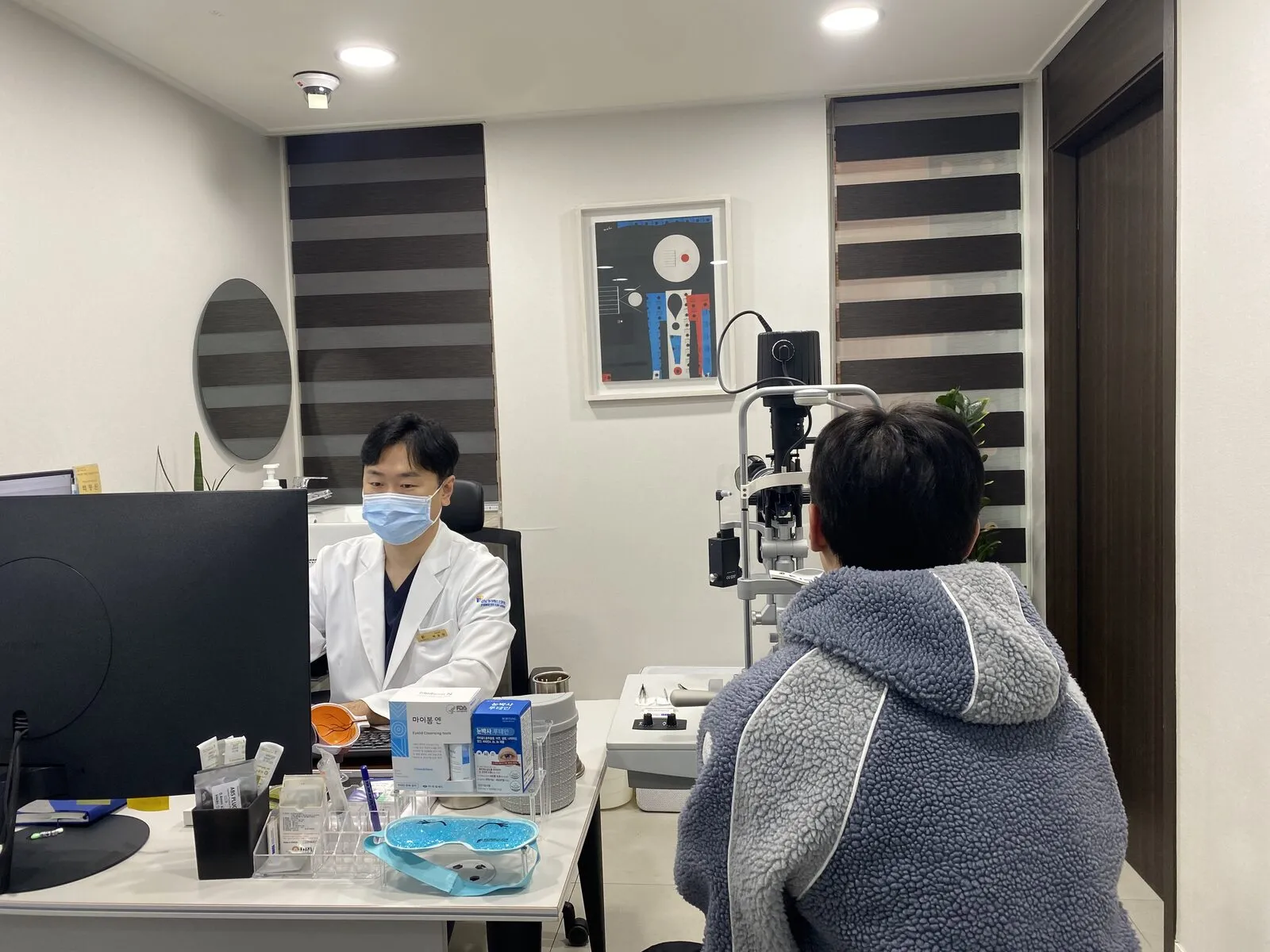
For ICL and lens procedures, I usually recommend a stay of 5 to 7 days. Cataract surgery replaces the eye's lens, so start from that range. Then adjust once your exam shows whether one eye or both need surgery and whether anything else in the eye needs attention.
We're open Monday, Tuesday, Thursday and Friday from 09:00 to 18:00 and Saturday from 09:00 to 16:00, with lunch from 13:00 to 14:00. We're closed Wednesdays and Sundays, and every visit is by appointment. If you land on a Tuesday evening, your exam can't be the next morning, because Wednesday is closed. Thursday is the earliest, so count the closed days inside your 5 to 7 before you buy the ticket.
| Stage | At the clinic | What you do |
|---|---|---|
| Arrival | Nothing yet | Rest; our site has directions from Incheon Airport by taxi, AREX plus subway, or limousine bus |
| Exam | Pre-op measurements and consultation with me | Bring your glasses, any eye records and a list of your medicines |
| Surgery | Morning preparation, roughly 10 to 20 minutes per eye | Arrange a companion or a taxi back; shield on for sleep |
| Follow-up | I check the eye again | Ask what to do if something changes on the plane or at home |
| Flight home | Nothing scheduled | Keep your drops in hand luggage |
For a week after surgery you sleep with an eye shield. You avoid strenuous exercise for a month, and you get a clear timeline for when you can wash your face and bathe. A slow walk around Seoul is fine. A hiking day is not.
Cabin pressure is generally not a concern after standard cataract surgery. Distance is. Once you're home, your surgeon is a long flight away, so the follow-up visit before you leave is the one I'd ask you to protect in your plans.
Say you're 67 and live outside Toronto. Your right eye has a dense cataract, your left a mild one, and night driving has started to make you nervous. I'd plan this trip around the right eye. If the exam shows the left lens can wait, there's no reason to squeeze both eyes into one week. Your night-glare tolerance would also steer the lens conversation, which I come back to below. And I'd suggest booking a check with your eye doctor at home a few weeks later, with copies of your surgery records in your bag. The CDC's medical tourism guidance also recommends planning follow-up care and carrying your records home.
Before you fix your dates, tell us on WhatsApp which city you'll fly home to and whether you have diabetes, glaucoma or a retinal condition. Those two details change how many nights make sense for you.
The lens decision comes down to four things we map during your consultation: which distance you most want clear, whether astigmatism needs correcting, how much night glare you're willing to tolerate, and how much you want to be free of glasses.
The method also shapes recovery. A monofocal lens usually feels settled sooner. With multifocal designs, the brain often needs weeks to months to get used to the new way of focusing. Halos tend to fade over that time for many people, but not for everyone. The AAO's overview of IOL implants explains the same trade-offs. If reading without glasses is your main goal, my post on what drives presbyopia surgery cost in Korea covers how premium lens choices change the plan.
A cataract trip to Seoul tends to suit you if your cataract has been diagnosed, your general health is stable, you can stay the 5 to 7 days and keep the follow-up visit, and there's an eye doctor at home who can see you in the weeks after. Diabetes doesn't rule you out; diabetic cataracts are among the types we treat, alongside age-related, traumatic and secondary cataracts. What counts is that blood sugar and the retina are stable.
If you're in your 40s with high myopia and a clear natural lens, cataract surgery usually isn't the conversation yet. A lens implant that leaves your own lens in place may be, and how ICL surgery cost in Korea is built works differently.
In the first days, blurry or fluctuating vision, a gritty feeling, light sensitivity and mild redness are common. For many people these ease over days to a few weeks.
As general medicine, it's usually better to wait if you have an active eye infection or inflammation, poorly controlled diabetes or blood pressure, another eye disease that needs its own plan first (such as uncontrolled glaucoma or active retinal disease), or if you can't use eye drops or attend the follow-up.
Rare but serious complications include infection inside the eye, retinal detachment and a lasting rise in eye pressure. Months or years later, the capsule behind the new lens can turn cloudy. A short laser treatment usually clears it. The National Eye Institute lists these risks too.
After you fly home, see an ophthalmologist near you the same day if vision drops suddenly, pain increases, or you notice flashes, a shower of new floaters or a curtain across your sight. Then contact us. Our Lifetime Aftercare means you can come back for a re-examination at any time, with re-treatment support if it's needed; the details are confirmed at your consultation. How your eye heals depends on its health before surgery, and your exam decides whether surgery is right for you at all.
Cost questions about cataract surgery usually come down to a handful of things:
The longer breakdown is in my post on what changes cataract surgery cost in Korea. For your own figure, ask on WhatsApp what it would cost for your case, with a photo of your latest exam report.
Reviews often say vision was clear by the next day. For distance, many people do notice sharper edges and brighter colors within days. Vision can still fluctuate for a while, and if only one eye has been done, the two eyes may feel mismatched until the second is treated or glasses are updated.
Another common line is that recovery was nothing. The operation is short, which is true. The weeks of drops, the shield at night and the month without strenuous exercise are what protect the result, and reviews tend to skip them.
Threads about multifocal lenses often claim the halos never go away, or that they vanish in a week. Neither holds for everyone. That's why night-glare tolerance belongs in the lens decision before surgery, not after.
You'll also read that you have to stay two weeks. Many people don't. The range I usually recommend for lens procedures is 5 to 7 days, adjusted to your eyes.
At EYEONCE, the surgeon who evaluates you is the surgeon who operates on you and follows your recovery. You're never handed off to someone you've never met. For a traveler that matters at the follow-up visit, because the person checking your eye knows exactly what was done inside it.
We only proceed if your pre-op precision exam confirms you are a safe candidate. We're a Seoul-government-registered clinic for international patients, with in-house interpreters on site in English, Chinese, Mongolian and Thai. If you're still weighing Korea at all, my overview for anyone considering eye surgery in South Korea covers the wider picture.
If you asked me how soon you could fly after cataract surgery, my first question back would be who looks at this eye three weeks from now, at home. A careful plan answers that before surgery day. Your outcome matters to me long after you fly home, and that's what Lifetime Aftercare is for.
Send a photo of your cataract diagnosis on WhatsApp, say whether you're thinking of one eye or both, and ask whether one trip is enough. When you come to Seoul, I examine your eyes myself and recommend the lens and the plan that fit them.
Results and suitability vary by individual. Your procedure recommendation is confirmed only through an in-person diagnostic exam.

Representative Director · Former Clinical Instructor, Dept. of Ophthalmology, Samsung Seoul Hospital · Member, Korean Society of Cataract and Refractive Surgery · Member, American Society of Cataract and Refractive Surgery
International patients share what actually happened — from their first fears to waking up the next morning without glasses.
Our patients share their stories on Google — verified, public and unfiltered. Open the map to read every review straight from the source.
Tell us your prescription and travel dates. Our English-speaking team will design your personalized plan — free of charge, no pressure.
An English-speaking eye clinic in the heart of Gangnam, Seoul — moments from Sinnonhyeon Station and easily reached from Incheon International Airport.
5–6F, Duo Sinnonhyeon, 368 Sapyeong-daero, Seocho-gu, Seoul, South Korea
+82-10-6308-0984 — English, Chinese, Mongolian & Thai
Mon, Tue, Thu, Fri 09:00–18:00 · Sat 09:00–16:00 · Lunch break 13:00–14:00 · Closed Wed & Sun
By appointment only · Registration may close early depending on the day’s schedule.
Sinnonhyeon Station (Line 9 / Sinbundang Line) — 3 min walk. Gangnam Station (Line 2) nearby.